My son, Barclay, is only eleven years old, but his life has already been marked by more diagnoses than most adults receive in a lifetime.
At 18 months, he was diagnosed with speech and language impairment.
At two, he was diagnosed with ADHD (Attention Deficit Hyperactivity Disorder).
At three, he was diagnosed with ASD (Autism Spectrum Disorder).
At five, he was diagnosed with an intellectual disability and unspecified anxiety.
At nine, he was diagnosed with Encopresis (a digestive disorder).
And most recently, we’ve added ARFID (Avoidant/Restrictive Food Intake Disorder) to the mix.
I’m sure this won’t be the last diagnosis we receive, but today I want to focus on ARFID—what it is, how we realized Barclay had it, and what has (and hasn’t) helped. If your child has ARFID, or you suspect they might, I hope something we’ve learned can make your journey a little easier.
What is ARFID?
ARFID is an eating disorder characterized by one or more of the following:
Extreme sensory sensitivities to temperature, texture, taste, smell and appearance of food.
Past traumatic experiences with food such as choking or vomiting.
Little or no interest in eating, sometimes related to conditions like autism that affect interoception—the brain’s ability to recognize internal sensations like hunger, thirst, or pain.
Is NOT characterized by body image or obsession with weight.
For a detailed definition check out the Diagnostic and Statistical Manual of Mental Health Disorders. (DSM-5)
Barclay’s ARFID Diagnosis
Looking back, I wish I’d recognized the signs sooner. But special needs parenting doesn’t come with a manual.
Until he was about 18 months old, Barclay ate everything we put in front of him.
Then I left for a girls’ trip with my oldest daughter.
While I was gone, Barclay got sick. Nothing serious, but he lost his appetite. The only thing my husband could get him to eat was canned peaches.
We assumed his appetite would return once he recovered.
It never did.
From that point forward, even canned peaches became difficult.
His pediatrician prescribed Pediasure, which our insurance covered because of how limited his diet had become. We tried supplements, but getting him to consume them was a battle.
At the same time, we were navigating brand-new ADHD and autism diagnoses. Compared to those challenges, eating fell to the bottom of the priority list. If he survived on Pediasure and canned peaches for a while, we could live with that.
Over the years, he slowly added a few foods. I jokingly called it his “nursing home diet”—soft, bland, room-temperature foods, and very little of them.
Back in 2018, I even wrote a blog post about his eating habits without realizing I was describing an eating disorder.
For years, we carried a thermos of mac and cheese everywhere we went. Before going to restaurants, I’d call ahead to make sure they served the one kind he’d eat. Traveling was incredibly difficult, especially since my husband’s family lives in Canada. We’d pack food in our suitcases because if we ran out, Barclay simply wouldn’t eat—even if similar foods were available.
Eventually, we couldn’t ignore it anymore.
ARFID was affecting his health, his social life (no pizza at birthday parties), our ability to travel, and his future independence. I knew we had to make it a priority.
Food Therapy
About two years ago, Barclay was finally thriving behaviorally, socially, and academically after years of speech therapy, behavioral therapy, social skills groups, academic intervention, and more.
For the first time, we had the bandwidth to tackle the one challenge we’d put on hold—eating.
His occupational therapist agreed to incorporate feeding therapy into his sessions.
We began with food chaining, which is introducing foods that were only slightly different from his safe foods.
For example:
Preferred chicken nuggets became chicken strips from the same brand.
Then nuggets from another brand.
Then grilled chicken instead of breaded.
Since he’d eat carrots in one specific soup, we experimented with carrots prepared different ways until we found another version he could tolerate.
Once he accepted a new food, it joined the rotation.
Later, we introduced food pairing, which is serving a preferred food alongside a less-preferred but tolerated food.
At first, his behavioral response was so intense that therapy had to happen in a private room.
A year later, he was eating outside with his therapist at a picnic table. Sometimes she’d intentionally pair him with another child because social eating often encouraged him to try new foods.
The progress was incredible.
He could finally order from a restaurant menu—as long as there was some version of mac and cheese or chicken.
He began eating foods Grandma mailed from Canada because we’d successfully chained them to foods he already accepted.
Most importantly, he started eating one meal my husband and I cooked.
That had always been my goal.
One family meal.
What We Do at Home
Monitor Progress
Every week Barclay weighs himself and records it on a chart.
Together, we look at whether he’s gained, maintained, or lost weight.
We’re careful not to make weight the focus.
But after he went an entire year without gaining a pound, his developmental pediatrician warned us that poor weight gain could affect his ADHD medication.
We want Barclay involved in understanding his own health. Teaching self-advocacy starts early.
Offer Choices
Choice has been one of our most effective tools.
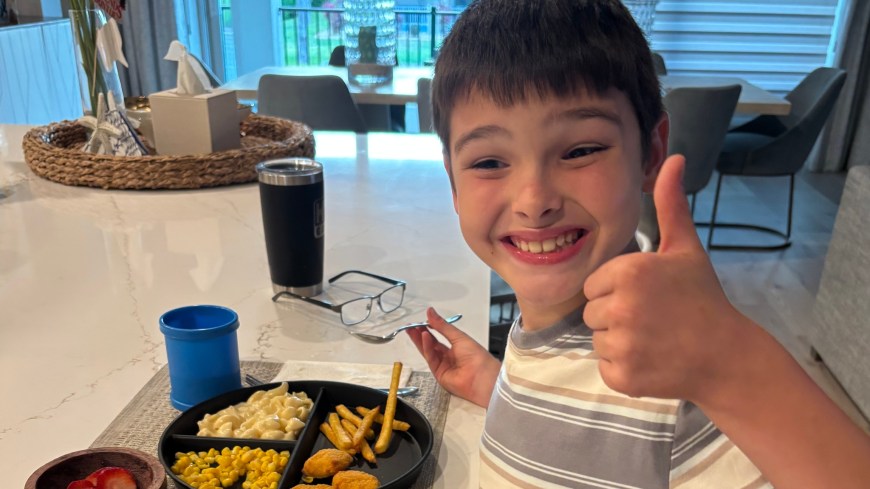
Weekly, I create a menu of all his preferred and less-preferred but tolerated foods, organized by food group. He chooses his protein, fruit, vegetable, carbohydrate, and beverage.
Originally, he picked all his favorite foods early in the week, leaving only less-preferred foods for later, which made meals miserable.
Now I spread preferred foods throughout the week so every day includes something he enjoys.
Giving him ownership has made a tremendous difference.
And yes—we allow weekends off. Everyone deserves a cheat day.
Eating Out
We no longer pack his meals or feed him before restaurants.
Instead, we choose restaurants where we know he’ll find something he can eat, then require him to order from the menu.
Years ago, that wasn’t possible.
Today, he can eat restaurant mac and cheese that isn’t his preferred brand.
That may sound small.
For us, it’s huge.
Travel
Our last trip to Canada was incredibly frustrating—for him and for us.
For ten days, he survived on little more than smoothies and scrambled eggs.
Over the past year, I kept reminding him, “We can’t go back unless you can eat the food.” Motivated by another visit—and with Grandma cheering him on from afar—he worked incredibly hard to expand what he could tolerate. And he did.
I also told him when we arrived in Canada, he’d need to try Grandma’s spaghetti and lasagna. He asked me to make them at home first so he could practice. So I did. While he didn’t love either dish, he ate enough to make his grandma—and his mom—proud.
Educate for Self-Advocacy
Perhaps the most important thing we’ve done is help Barclay understand his diagnosis.
He knows he has an eating disorder.
He understands when it began and why we’re working so hard.
We respect that his sensory experiences are real, while also helping him build the skills he’ll need to travel, spend time with friends and family, and someday possibly live independently.
Current Struggles
Despite all his progress, eating is still hard.
Barclay eats very slowly, which often causes his brain to register fullness before he’s consumed enough calories.
We’ve shortened mealtimes and eliminated distractions like television and electronics so he can focus on eating.
Some days are easier than others.
Bottom Line
Like many of Barclay’s diagnoses, ARFID will probably be part of his life forever.
People often say things like, “All kids are picky eaters,” or “He doesn’t look underweight.”
I know they’re trying to be reassuring.
But every meal in our family requires planning, patience, and persistence.
Every. Single. Meal.
If someone you love has ARFID, I see you.
The road is long.
Progress is slow.
But progress is possible.
An eating disorder is not a phase or a goal. It’s a disease. End of story.
Amy Nielsen is a Senior Literary Agent at The Purcell Agency. She is also an autism advocate and author. Her works include Goldilocks and the Three Bears: Understanding Autism Spectrum Disorder, It Takes a Village: How to Build a Support System for Your Exceptional Needs Family, and her young adult debut, Worth It. She is also a freelance editor and caregiver coach helping families navigate the early days of an autism diagnosis. When not reading or writing, Amy and her family can be found boating the waters of Tampa Bay.
View all posts by Amy Nielsen
2 thoughts on “Barclay’s ARFID Journey: Avoidant/Restrictive Food Intake Disorder”
Sounds incredibly difficult. I’m new to your blog. Does Barclay have siblings? Is he high functioning?My older brother was autistic, low functioning, and nonverbal. I know how hard my parents had it in the 1950s, when little was known about autism. Thanks for posting.
Hi Davisbrotherlylove, Thanks for the comment. I appreciate it. That must have been so tough for your parents back then. So little was known about autism. Barclay has three wonderful adult siblings. He’s very lucky! As far as his functioning level, currently, using terms like high-functioning and low-functioning is considered outdated by autism self-advocates, clinicians, etc. Those terms were once used, but low-functioning can minimize strengths and high-functioning can minimize challenges. Instead, we describe Barclay’s specific autism in terms of what his strengths are, his challenges, and his support needs, which fluctuate on the daily! Have a great day! Thanks again for commenting! 🙂



Sounds incredibly difficult. I’m new to your blog. Does Barclay have siblings? Is he high functioning?My older brother was autistic, low functioning, and nonverbal. I know how hard my parents had it in the 1950s, when little was known about autism. Thanks for posting.
LikeLike
Hi Davisbrotherlylove, Thanks for the comment. I appreciate it. That must have been so tough for your parents back then. So little was known about autism. Barclay has three wonderful adult siblings. He’s very lucky! As far as his functioning level, currently, using terms like high-functioning and low-functioning is considered outdated by autism self-advocates, clinicians, etc. Those terms were once used, but low-functioning can minimize strengths and high-functioning can minimize challenges. Instead, we describe Barclay’s specific autism in terms of what his strengths are, his challenges, and his support needs, which fluctuate on the daily! Have a great day! Thanks again for commenting! 🙂
LikeLiked by 1 person